How to Build a Production-Ready Next.js Website with AI in 2026
8Flow Team
Enterprise Web Architecture Team
Direct Answer
Building a production-ready Next.js website in 2026 using AI involves replacing manual coding with an Enterprise AI Web OS like 8Flow. By utilizing semantic blueprinting, concurrent code compilation, and autonomous deployment to Vercel, founders can launch high-converting, fully responsive Next.js stacks in minutes rather than weeks.
In 2026, 80% of searches are zero-click, as AI Overviews satisfy intent instantly. To survive, developers must shift from ranking to "Answer Presence" using an AI Web OS like 8Flow. Winning requires being a cited source, yet only 12% of AI citations currently match Google’s top-page results—making technical extraction the new SEO priority.
Pro-Tip:Researchers have found that outbound links placed inside the Answer Capsule itself actually reduce citation likelihood. Keep your outbound citations in the supporting paragraphs to ensure your site remains the authoritative answer source.
Why Traditional Development is the "Inefficiency Tax"
For a Senior Architect, the "Inefficiency Tax" isn't just a cost—it’s a technical debt incurred by disjointed tools and slow-moving agency retainers.
In the wake of the February 2026 Discover core update, which explicitly increased the weighting of Information Gain, simply restating existing facts is a recipe for invisibility. Legacy stacks are failing because they cannot provide the Value-Added Provenancerequired to pass today's quality gates.
8Flow eliminates this operational overhead by functioning as an Enterprise AI Web OS, moving from manual orchestration to high-throughput compilation.
Development Velocity: 2024 vs. 2026
| Development Phase | 2024 (Traditional Stack) | 2026 (8Flow AI Web OS) |
|---|---|---|
| Semantic Mapping | Weeks of manual niche audits | Seconds of AI-driven strategy blueprinting |
| UI/UX Strategy | Prototyping in Figma/Framer (no code) | Concurrent compilation with production CSS |
| Next.js Engineering | Manual React Server Component (RSC) logic | Production-ready Next.js App Router rendering |
| Infrastructure | Manual CI/CD and Vercel config | Autonomous push to GitHub & Vercel deployment |
Step 1: Semantic Blueprinting and Strategy Mapping
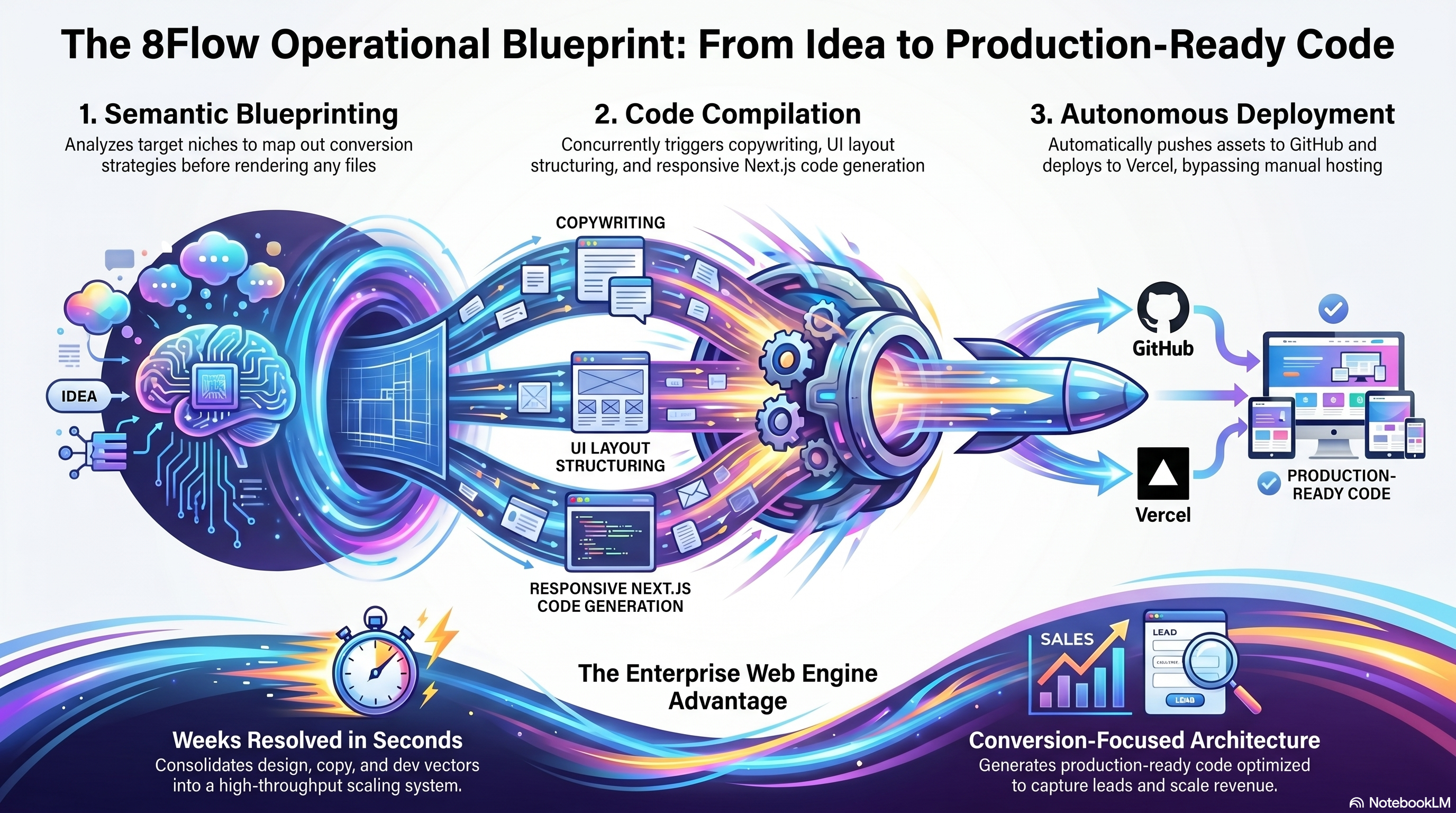
The 8Flow operational blueprint begins with Semantic Blueprinting. Before a single file is rendered, the system audits target niches and maps conversion strategies.
This replaces the manual process of target audience analysis with an automated evaluation of pain points and "Query Fan-out" potential. This phase ensures the site architecture addresses not just a primary question, but all adjacent sub-questions in a single document, maximizing retrieval confidence for AI agents.
Step 2: Concurrent Code Compilation (Next.js + UI/UX + Copy)
Once the strategy is mapped, 8Flow triggers three development vectors concurrently:
- Copywriting: Generating high-converting text that prioritizes "Information Gain."
- UI Layout Structuring: Designing responsive, conversion-focused interfaces.
- Next.js Compilation: Rendering the technical frontend architecture via the Next.js App Router.
Unlike "unfalsifiable mush" generated by generic LLMs, 8Flow ensures the React Server Component (RSC) tree is optimized for AI extraction. By pre-rendering content, we ensure that AI agents—which often lack the compute to execute complex client-side JavaScript—can retrieve your data in the initial HTML fetch.
Step 3: Autonomous Deployment to Vercel and GitHub
The transition from local rendering to live production is handled without manual intervention. 8Flow pushes clean code assets to a GitHub repository and deploys them to Vercel, bypassing the complexity of manual hosting.
The Ultimate Web Engine: Technical Advantages
- Zero Complexity: Bypasses manual server and CI/CD pipeline configurations.
- Crawl Efficiency: Optimized for AI agents that prioritize server-rendered content.
- Lead-Capture Ready: Integrated components designed for immediate conversion.
- Backend Interoperability: Clean, "code-first" Next.js stacks ready for enterprise API integration.
The "GEO-Ready" Advantage: Optimizing for AI Citations
To win in 2026, you must optimize for Generative Engine Optimization (GEO). Research from Princeton indicates that optimizing for specific "citable" traits can boost visibility by 15–40%.
The Four Traits of AI-Citable Content
- Statistics: Replace vague claims with specific data. (e.g., "Content updated within three months averages 6 ChatGPT citations vs 3.6 for outdated pages.")
- Source Citations: Use hyperlinked evidence to allow the AI to verify claims via its own retrieval loop.
- Expert Quotations: Attribute insights to named experts via Entity Reconciliation. Connect authors to the Knowledge Graph using sameAs schema and Wikidata QIDs.
- Readability: Maintain 120–180 words between headings to facilitate AI "chunking."
Structural Entity Density and the "Ski Ramp"
8Flow handles structured data (FAQPage, HowTo, Article) out-of-the-box to achieve an Entity Density of 20.6%—the benchmark for heavily cited content—compared to the 5-8% found in standard text.
Furthermore, we employ the "Ski Ramp" distribution pattern: since 44.2% of LLM citations are extracted from the first 30% of content, 8Flow's architecture prioritizes high-impact insights and Answer Capsules at the top of the DOM.
Comparative Analysis: 8Flow vs. Legacy Stacks
| Platform | 2026 Strategic Capability | Critical Technical Bottlenecks |
|---|---|---|
| WordPress | Large plugin ecosystem | Severe Crawl Budget inefficiency and plugin bloat. |
| Framer | High-fidelity visual design | Lacks Semantic HTML and SSR; content often invisible to AI. |
| Webflow | Visual web design | Rigid custom code limitations; difficult Next.js integration. |
| 8Flow | Enterprise AI Web OS | Built-in Entity Density and Information Gain optimization. |
Troubleshooting Technical Blockers for AI Crawlers
Even the best Next.js site is dead on arrival if AI bots are blocked at the infrastructure level. Perform this 10-minute audit:
- Robots.txt & Permissions: Ensure you are not blocking GPTBot, ChatGPT-User, or PerplexityBot.
- Cloudflare Nuance: Note that Cloudflare changed its default configuration to block AI bots in 2024. You must manually whitelist these agents in your WAF settings.
- SSR vs. JS Rendering: AI agents often cannot render dynamic, client-side content. If your content doesn't exist in the initial HTML source, it won't be cited.
- Server Log Audit: Search your logs for ChatGPT-User. If it’s missing, bots aren't reaching your site—fix your permissions before optimizing content.
Conclusion: Scaling to 10x Output
The 2026 digital landscape has fundamentally shifted from "Information Retrieval" (finding links) to "Information Gain"(extracting unique value). Current data proves that only 37.9% of URLs cited in AI Overviews rank in the top 10, proving that the traditional "Ranking #1" goal is no longer the sole metric of success.
By adopting 8Flow’s AI Web OS, founders and agencies can turn ideas into production-ready, GEO-optimized code at lightning speed.
Ready to 10x your output and secure your Answer Presence?
Join the founders and agencies scaling their brands with 8Flow Automation today.
Get Started FreeUpload infographic to:
/public/blog-assets/how-to-build-nextjs-sites-with-ai/infographic.png
Frequently Asked Questions
What is an Enterprise AI Web OS?
An Enterprise AI Web OS is an integrated platform that handles copywriting, UI/UX design, and code compilation simultaneously, bypassing traditional manual development.
Does AI-generated Next.js code rank on Google?
Yes, provided the generated code utilizes proper semantic HTML, structured data, and loads quickly. 8Flow ensures strict adherence to Core Web Vitals out-of-the-box.